Monday, June 25, 2012

Riddles and Prophesies and Puzzles, Oh my!


Riddle me this?

Do you know Blain the Mono and his riddle game? Have you read Stephen King's Gunslinger series?

How about Tolkien's The Hobbit?

What's it got in it's pocketssss?

Or Gregor the Overlander by Suzanne Collins, where prophecy acts as riddle?

So many stories, be they thrillers, mysteries, fantasy, science fiction, or contemporary (AS King's Everybody Sees the Ants) are dependent on secrets that need to be figured out by both the protagonist and, at the same time, the reader. Sometimes they are obvious plot points and sometimes they are games within the larger story that resonate again and again. Prophecies are great plot devices that can act as riddles for larger (macro) stories that surround the details of smaller ones, revealed over the length of a book or the course of a series of books. They are especially satisfying, just like a good riddle, when solved.

What's it got in it's pocketsss?

So here's the writing prompt for this Monday, a day filled with the promise of futures to be revealed. Write me a riddle, a prophecy, a puzzle, a trap, or an opening mystery - anything that needs to be solved that starts a scene. The character(s) are up to you, as is the time, place, genre. It can be short - a single sentence, or long (but no more than 100 words). But give us something to be solved and make us ask, "What happens next?" Oh yeah, give us a title too, just to make it interesting...

We'll take submissions through next week, July 5th and post the best.
- Joe

Thursday, June 21, 2012

From Wargarous to Monocles: an Interview with EJ Patten, Part III of IV


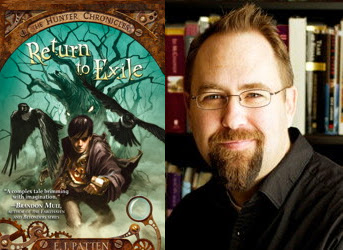
Welcome back to part three of Wargarous to Monocles, an interview in four parts with EJ Patten, whose favorite subjects are Ramen noodles and Vienna sausages and who is the author of Return to Exile... I know I'm a day late. It's supposed to be 4 Thursdays in a row but work with me will you?

Joe: Return to Exile is Middle Grade Fiction – a tough marketing job, as you have stated on your blog. So tell me, why write middle grade fiction? How did you end up with a middle grade story instead of a YA or adult tale or a Buddhist monologue, and what do you think of the genre you write in? Oh yeah, and there was that little question about why you were fired...

Eric: Okay, so I should probably address the firing question before I dive into the middle grade question. Once upon a time, I designed high-end training courses for consultants and bestselling business book authors. I have a lot of stories about this, and why I was fired, but they’re all very boring—not nearly as cool as your story. To sum up, both firings came down to the same issue: I challenge bad ideas regardless of who proposes them and I’m not always circumspect in my approach, even though I try. The problem was that some of the people I reported to assumed that I was challenging them rather than their ideas. The fact that they had a lot of bad ideas didn’t help matters.

Fortunately, the people I work with these days—like my agent and editor—have very good ideas and we make these ideas even better by leaving our egos at the door when we talk. Of course, we don’t have to deal with all the roadblocks and political maneuvering that makes excellence so difficult for corporations to achieve, but that’s a topic for another time. Or not.

You asked about why I write middle grade fiction rather than something else, especially considering how hard it is to sell and market these days. Years ago when I was an undergrad in the film program, I had two screenplays/books I wanted to write: One was middle grade (though I didn’t know what that was at the time); the other was historical fiction. Both were pretty strong ideas, and I wasn’t sure which to pick. The second Harry Potter book had just come out and someone recommended the series, so I bought it. Harry Potter hooked me like no other series had in a long time and I thought, “That’s what I want to write!” It was intriguing and fun and dark and imaginative all at the same time.

Then, life got in the way and things didn’t work out. I was derailed for a number of years. I suspect that if I’d written Return to Exile back then, sales and marketing would’ve been easy. Harry Potter ushered in a heyday for middle grade books. Then, Twilight ushered it right back out and into young adult. If there’s an “it,” and if that “it” is somewhere, YA is where it’s at.

I can name several recent YA hits by debut authors, but I can’t name a single MG hit written by a debut author within the last five years. And by hit, I mean a breakout hit with sales in the millions. The biggest MG series and authors today all started just before the last Harry Potter book was released in 2007: Percy Jackson, Fablehaven, Diary of a Wimpy Kid, The Mysterious Benedict Society.

It’s possible that it simply takes five years to reach breakout levels; it’s also possible that Harry Potter, which had captured a huge and diverse audience, left a hole in the market and these series and authors stepped in to fill it and have owned it ever since. By the end of Harry Potter, we were well into YA territory, and I suspect that Twilight, which came out in 2005, captured the biggest share of the readership and put the focus on YA.

So what does all this mean? I have no idea. More importantly, I don’t really care.

I write middle grade fiction because I love middle grade fiction. It’s imaginative and fun and exciting. It can be scary or funny, light or dark, adventurous or thoughtful, or all of the above. Adult speculative fiction is almost never fun. Young adult is seldom adventurous. Writing great middle grade fiction requires a finesse and balance that you don’t find in other genres, and your readers are both more and less forgiving. Younger readers will forgive typos, grammatical mistakes, and sloppy writing, but they’ll never forgive you if you bore them. With adults, the opposite is true. With young adults, you can be as sloppy and boring as you want so long as you engage their hearts.

Of course, in the midst of engaging middle grade readers, I don’t shoot for sloppy or heartless. I doubt any writer shoots for this, though some hit the target anyway because they don’t take time to aim.

The difficulty comes in the balance: If I’m writing non-stop action, by definition I’m not stopping to engage a reader’s heart, and if I’m talking about my cool world page after page, I’m not talking about my main character who lost her Aunt Suzie to a rabid falcon when she was young. The most balanced stories start with character and branch out from there. Character moments are almost always slower moments, which is fine for adults and young adults, but not as fine for middle grade readers. This is why so many middle grade books since Harry Potter feel shallow to older readers, because they sacrifice character in favor of action to quickly engage their audience. The breakout hits, like Percy Jackson and Fablehaven, don’t sacrifice character, which is why they appeal to older readers and is one of the reasons why they’re breakout hits in the first place. The finesse comes in trying to find ways to keep action-focused middle graders reading through the setups and character moments in the early parts of the book, but that’s what I try to do. I try to layer my stories so that they’ll appeal to all readers.

I think that’s what Harry Potter did so well.

The market has fragmented since then, and reader’s tastes have changed, but I think that a well-written book that engages the heart and mind will always find a home, no matter the genre.

But I write middle grade fiction because I love it. That’s not to say that someday I won’t write a YA book, or something for adults, but for now, I’m going to stick with middle grade, assuming people keep buying my books.

How about you, Joe? Why write YA (and historical YA, at that)?


Joe: First I think we all should take a moment and write this quote down. It's brilliant. Even if you don't want to, humor me.


"Younger readers will forgive typos, grammatical mistakes, and sloppy writing, but they’ll never forgive you if you bore them. With adults, the opposite is true. With young adults, you can be as sloppy and boring as you want so long as you engage their hearts." 


I remember once sitting in a theatre in the upper west side listening to all kinds of people (actors, politicians, writers) read from beginning to end, out loud, to commemorate the life of James Joyce, the novel Ulysses. It was Bloomsday. The first actor (who was it? never mind) said something about how he'd never read the book and thought that most people hadn't. He said it was like one of those books you were supposed to have read but found too navel gazing to actually get through. That has stuck with me. Adults will forgive boring writing but not grammatical mistakes. That's perfect.

So now that I've insulted James Joyce I'd better move on to your question.

I have always loved reading Middle Grade and YA novels. I just have. I browse bookstores and the kids section is a treasure trove. So is the sci-fi and fantasy and mystery sections. I've also always loved historical novels.

But I never set out to write either. I pretty much wrote contemporary, adult material and fantasy stories when I came upon Open Wounds. An agent gave me the advice to make the book either an epic story of Cid Wyman's life and come in around 6-700 pages or do a YA version of his childhood. I took the YA version by changing the voice of Cid from an old man looking back to a boy's perspective on his own life. By all rights and the age of the protagonist it should be an MG book but the content is too harsh (or so I've been told) for MG. So I didn't write a YA book I just reworked my adult book with a new voice and it worked better that way so I was happy with it.

As for writing an historical novel I came up with Cid Wyman's character first as a 72-year old man and as I worked backward trying to figure out who he was and where he'd come from I found myself in 1936 at the opening of Captain Blood just after Christmas. I didn't find it. It found me. I really enjoyed the research and love that time period in New York City so it all just jelled. I liked it so much I'm writing another historical YA that takes place in a time and place I'm also fascinated with - WWI, the western front, Flanders Field. It's surprises like this that can make writing so cool.

Now here's your last question. John Rocco is a wonderful illustrator and did all the work in your book and a lot of the images on your website (all in this post). Tell me about the process of working on your cover, of hooking up with Rocco, and about how you envision the characters and creatures in your books.
Come back next Thursday as EJ and I go back and forth for one more once. In the mean time the give-away at the end of the interview (closing date for entry is July 2 and winner will be announced Friday, July 6) will be a critique of up to 10 pages of manuscript by EJ himself. I'm not kidding. It's the real deal.  You’ll get one entry for each of the following: mention the interview on Facebook; tweet about the interview on twitter; and/or become a follower of Gotteenfiction.
- Joe

Got Inspiration?


I'm a day late on this inspiration post--mainly because I had a bad day yesterday on a bunch of fronts and couldn't come up with anything peppy or inspirational. My mood just wouldn't let me go there.

As a writer, you have days like that, where you can't even bring yourself to put pen to paper or fingers to keyboard. Some days I'd say you should push through and others you may just need to give yourself the day off.

But, wait, this is supposed to be an inspirational post. So here it is--take the feeling you get on those bad days and use it in your writing. Think about how you are feeling and the types of things you do. Do your feet drag? Is it impossible to smile? Do tears dot your eyes at various times during the day?

I've heard of writers who have broken bones and their first thought is, "I can use this!"

As a writer, the negative can almost always be turned around.

And as it says in the picture above in a quote by Henry Ford: "Whether you think you can or you think you can't, you're right."

~Shari

Friday, June 15, 2012

Here's Fire's wonderful dialogue between Anthony and Destinee on prom night. Great work!


"Anthony I didn’t plan on telling you like this. I swear.” 
         He didn’t look at me.
“Anthony please say something.” I heard my voice begin to crack.
“What do you want me to say, that I was in love with you for two years and didn’t do anything about it, or that you’re someone other than you said you were.” 
I didn’t know how to respond, I wanted to comfort him but I was scared to get close to him. I didn’t want to lie to him, but there was no other way.
“I didn’t mean to lie to you about it. You have to believe me Anthony. And if you only knew the danger my secret puts you in.” 
He turned on me pushing me against the wall, fear striking his eyes.
“I don’t care about the danger. Damn it, Destinee. Do you honestly think I would think of you any different?” 
I felt the tears forming in my eyes but pushed them back.  “Of course not.”
         “Then why didn’t you tell me?”
“I was scared. I was scared they would find out and take you away.” 
He laughed slightly relaxing his shoulders. “I’m not some weak boy, I wouldn’t let them take me from you.” 
I didn’t hold the tears back this time, letting them fall Anthony pulled me closer whispering in my ear,“You have always been my angel Destinee, now you’re just the real thing.” He forced a smiled and left walking into the men’s room of the Grand Chalet.
    I leaned close to the door listening to the sound of him pacing back and forth, the sound of a flask coming out of his jacket pocket. He sucked down a mouthful of rum. I listened to him wince as he coughed at the burning pain in his throat. Prom night was not supposed to happen like this. 
Anthony didn’t know what to think about what Destinee had just told him, that she was a fallen angel, that she left heaven to save his life. Anthony slammed his fist into the stall door.How was he going to deal with the entire heavenly coven after his soul and after the one trying to protect it?


by Fire


After reading this I think we're all rooting for Anthony & Destinee! I hope they get in one slow dance before the coven strikes. Thank you, Fire and to all who submitted! If it's your prom weekend, have a great one!


Karen 


Scroll down to the June 11th post. We'd love to know how YOU deal with writer's block.

Wednesday, June 13, 2012

From Wargarous to Monocles: Interview with EJ Patten, part II


And now for part II of our epic interview with EJ Patten, author of Return to Exile...

Joe: You say survival is the great universal theme and your personal tale of survival - of which I’ve had only glimpses from what you’ve written on your blog, in interviews and earlier here – has been strewn with hardship and your share of darkness. Tell me about your survival as a writer. What event or events helped you transition to maturity so that you could call yourself writer with a capital W?

Eric: I like your answer about joy and authenticity: Power comes from the strength of the underlying emotion. Now creating that emotion within readers…that’s the kicker. People seem far more likely to believe in bad luck than good. You can dump on a character all you want, but the minute you give a character a lucky break or enduring happiness, people lose interest or start crying “deus ex machina!” They just don’t believe it. Now, I’m talking about actual joy and happiness, not the adrenaline rush and excitement that comes from an action/adventure story; that’s a different monster entirely.

Stories thrive on conflict, and joy and conflict don’t get along very well outside of a comedy. You can start a story with a joyful event that turns tragic and you can end a story with a tragic event that turns joyful, but in the middle, joyful events stretch credibility except in small nostalgic doses that are quickly crushed. 

Why?

I think a non-comedic story that’s full of joy isn’t believable because it’s so far removed from our normal experience. And yet…you can write a straight tragedy without a single joyful moment and people will love it, even though that’s not true to our normal experience either, so maybe that answer doesn’t work. I don’t know. Maybe it’s just that joy is meaningless without misery and that the appreciation only comes in the contrast. Or maybe we just don’t like reading about people who are happier than we are. That’s a depressing thought.

On that happy note, let’s move on to your question. You asked about how I became a writer with a capital “W.”

It’s funny, when people who don’t know me ask what I do, I tell them I’m a writer. I love to watch the gears churn in their head and hear the fearful catch in their voice as they reply, “oh…what do you write?”
At this point, they’ve made one of two assumptions:
  1. I’m a technical writer who creates documentation for something very boring, and I’m about to bore them to death with woeful tales of typesetting problems, editing worries, grammatical mishaps, and printer malfunctions.
  2. I’m unemployed and likely to hit them up for money.
Not wanting to disappoint, I usually follow up by saying I’m a technical writer who’s between jobs, and would they mind loaning me a few bucks for cab fare so I can get home to fix my printer, which has been suffering terribly ever since I failed to capitalized “subcutaneous” after a colon, even thought it was clearly part of an independent clause; “you do know what an independent clause is, don’t you?” I say. They then either pony up the cash or make up a hasty excuse and flee, allowing me to continue sampling the Vienna sausages and staring at the wall, undisturbed.

My wife has asked me to stop messing up her dinner parties and simply tell people I’m an author, but where’s the fun in that? Besides, if I tell them I’m an author, the conversation goes like this:

“So what do you do?” they ask.

“What do you mean?” I say. “Are you talking day to day, or is this an existential question?”

“Day to day.”

“Oh,” I say, disappointed that the conversation has suddenly become less interesting. “I’m an author.”

“Really?” they say in surprise. Then, hesitating—clearly wondering if I’m legitimate—they add, “Have you written anything I would’ve read?”

“I don’t know,” I say. “Tell me what you’ve read and I’ll stop you if you get to one of my books.”

They laugh nervously. “To be honest, I don’t read that much.”

“You don’t say.”

“I listen to audio books sometimes. Are any of your books on CD?”

“Afraid not. After Telly Savalas died, I determined that no one could do my books justice. It’s all about the voice, you know.”

“I don’t know who that is.”

“Telly probably didn’t know who you were either, but someday, maybe. I’m working on a reanimation program to bring him back from the dead so he can create my audio books, but so far, no luck. You don’t happen to know of any satanic rituals I could perform that might help, do you?”

Another nervous laugh. “Well, I should really get back to the party. It was nice talking to you.”

“You, too,” I say. “Hey, before you go, could you spare a couple dollars for cab fare…”

Anyway, you get the idea. “Writer” and “author” are both loaded terms, but usually not in a monetary sense.

Fortunately, I’ve gotten lucky as an author. I’m one of the few who makes enough to write full time. There aren’t many of us. Advances seem to grow smaller and smaller everyday and the costs of cardboard-box houses and Vienna sausages keeps going up.

Surviving as an author is hard, and not just because Ramen has risen over three cents this past year (seriously people, I’m not a king here!).

To be an author, first, you have to write something. Preferably more than a sentence. A book is ideal.
Second, you have to get an agent. Third, you have to get an editor to buy your book. Fourth, you have to get everyone else to buy your book. Fifth, you have to write another book because the advance for the last one has run out and the cost of Ramen noodles has risen over three cents in the last year (three cents! We’re authors, not oil tycoons!).

Many events pushed me along the path to writerdom, but there are four major events I can point to that led me to where I am now:
  1. Getting booted out of my creative writing class in high school shortly after I figured out that I love to write. It was heartbreaking. Fellow students enjoyed my stories. My teacher, however, did not. Also, I stayed home and read all day. Apparently schools don’t care whether or not you turn in every assignment; they also want you to attend. Who knew?
  2. A college creative writing professor asked for samples of my work to share with future classes. For the first time, someone in a position of influence appreciated my writing. It was weird. I don’t know if he ever shared those stories—he died of cancer a few years later—but he encouraged me.
  3. Getting fired twice within three months. It turns out I’m not very good at managing up. I don’t like reporting to people and I never quite figured out how to do it. The demands of supporting a family and trying to survive had forced me to put writing on the backburner for a time, but getting fired twice within three months (did I mention that part? Real self-esteem builder, let me tell you) changed everything and I started writing again. Before, I’d focused (unsuccessfully) on screenwriting. This time around, I decided that I was tired of working with other people, which screenwriters have to do, so I wrote a book—the book that became Return to Exile.
  4. I got an agent. Nothing instills confidence like having an agent say, “your story doesn’t suck.” And Steve, my agent, said more than that. He was so positive that I blushed. Working with him has been amazing. So much of writing is a mental game. Eventually, you build up some calluses—and you need them—but early on, every little review can have such a huge impact. The first few months after Return to Exile came out, I would fly high in the morning from a gushing review and crash in the afternoon because some random person I’d never met pointed out some flaw. Those sorts of highs and lows are death to writing. You can’t focus. You need the calluses.
I think I’ve rambled on enough for the moment. Now, Joe, it’s my turn for the question: What’s the most unique response you’ve seen from someone who’s found out you’re an author? If you don’t have anything interesting, feel free to lie.
Joe: First, give me a moment. I was laughing so hard I had tears in my eyes. Which is a good thing because it washed the image of Telly Savalas sucking on a lollipop from my mind.

So, before I get to your question I have to ask you why got fired from each of the two jobs you got fired from. I mean it’s just sitting there, waiting for me to ask and, yes, I’m curious. I think everyone should get fired from at least one job in their life (as our earlier discussion pointed out – life experience, especially hurtful, painful, miserable, rotten, despicable, mind-numbingly horrific, okay, okay you get the picture – is important to a writing life). Me, I’m still trying to get fired. They keep promoting me instead. Maybe I should take a different tack. I should have been fired from jobs a number of times. Here's an example.

When I was a Friendlies customer service supervisor (say that five times real fast) and on my shift one sunny summer afternoon myself and my staff were all participants in an epic water balloon fight  that spanned from the dishwasher (a Hobart 1000) to the front restaurant, to the kitchen, to the rooftop. The store manager came in and caught me with balloons in hand. I told him the water balloons were all mine and that his son, who was still up on the roof planning a bombing raid, had nothing to do with it. I didn’t get fired. It’s a good thing he never saw the whip cream whippet gunfights we had that evening or the last man standing by the Hobart 1000 water hose death match and banana launching.

Now back to your question. What’s the most unique response I had to someone finding out that I was an author? Truthfully it’s still kind of new. For years, while I slogged away trying to sell my first novel (some 10 years and four different first novels) I stopped telling people that I was a writer. I did this because I found that once people knew that I wrote, they kept asking me, “How’s the book going? Sell it yet?”

Now what I wanted to say was, “Don’t you think I’d have told you if I had sold it?” Yes, yes, I might have thrown in a four letter word or two there like butt-head. But what I said instead was, “No.” This made family get-togethers pretty awful experiences. I found this so debilitating after a while that I just stopped telling people I was a writer. It was either that or hide in a corner under the upholstery. What people didn't know about they couldn't ask about. And by then most people had stopped asking if I’d sold my book yet, because they couldn't find me.

Just before I sold my book, I’d almost started to believe that I wasn’t an author - that it just wasn't in the cards for me. I started believing again when my agent called with a book deal in hand. Since then people think I know something about writing - because I'm an Author. The day before I found out I had a book deal I knew nothing. The day after, I knew everything and could write essays about it and do long interviews.

I call it the writer’s light switch. Nobody. Somebody. Nobody. Somebody.

Now back in your court. Return to Exile is Middle Grade Fiction – a tough marketing job, as you have stated on your blog. So tell me, why middle grade fiction? How did you end up with a middle grade story instead of a YA or adult tale or a Buddhist monologue, and what do you think of the genre you write in?  
Come back for the next two Thursdays as EJ and I go back and forth picking up the threads of the interview throughout the month of June. In the mean time the give-away at the end of the interview (closing date for entry is July 2 and winner will be announced Friday, July 6) will be a critique of up to 10 pages of manuscript by EJ himself. (I want in on that.) You’ll get one entry for each of the following: mention the interview on Facebook; tweet about the interview on twitter; and/or become a follower of Gotteenfiction.

got inspiration?

Well Read New & Used Books (a very awesome independent bookstore) in Hawthorne, NJ hosted the launch of Hawthorne High School's literary magazine "The Empyrean" two nights ago. 

A packed house of students, parents, grandparents and community members turned out to hear readings by student authors that were A-MAZ-ING! 

Was I inspired? You betcha! And I promised I wouldn't steal anything I heard or read that night. Well, maybe I had my fingers crossed behind my back...

I had the pleasure of being one of three judges for the magazine's fiction contest which gave me some insight as to what editors go through. They may love 10 submissions but have room for only 3 books on their list. Yikes! Yes, judging was tough because every entry brought something special to the table. After the winners were announced, I got to chat with all the talented writers.

Check out this link to the Empyrean's stunning color edition of the magazine which also includes student artwork. Again, WOW!

Congratulations to: 1st Place Winner: The Encounter by Mike Verdon (page 14)
                               2nd Place Winner: The Doctor Told Me So by Cecilia Schiavo (page 22)


~~Karen


Monday, June 11, 2012

Got Writing? A Blank Page

As writers, we are often stuck staring at a blank page. Sometimes it happens before you even start your project, sometimes it happens mid-story. Sometimes it happens just as you are nearing the end.


The question is--what do you do if this happens?

Different writers have different ways of dealing with writer's block. Some go for walks or go to the gym. Others find that taking a break for a while helps. Some writers turn to other projects or will write something silly or totally unrelated to their current project. Still others need to plow through and will sit and stare at that screen until something comes out. 

One thing I've found helpful when I'm not sure where my story is going is to journal for my characters or write letters between them. This often unlocks back story, reveals to me their motivation and shows me how they might react to certain situations.

The other thing I recommend is research. When I was writing Change of Heart, the more I spoke with people who had received a heart transplant, the more the storyline because clear to me. Often learning extra realistic facts can shape both your characters and your plot.

What methods do you use when faced with writer's block?